
Build a USP Hazelton Timeline
A federal release timeline begins with the federal judgment and BOP identity record. Obtain the sentencing court, docket number, full name, and BOP register number. The judgment states the prison term and any supervised-release term. An amended judgment or later court order can change the legal framework, while the locator and BOP record show how prison custody was carried out.
Keep each event label intact. A projected BOP date is not an actual release date. A move between USP Hazelton and another BOP institution continues federal prison custody. A released or not-in-custody result ends BOP custody only. It can be followed by federal supervised release, ICE detention, state or local custody, or another placement named in the records.
| Federal source | Question it answers |
|---|---|
| Federal judgment | What sentence and supervision the court imposed |
| BOP locator | What public status, location, and date BOP reports |
| BOP event record | What operational custody change occurred |
| Federal docket | Whether later court action changed the terms |
| Receiving agency | Whether another custody began afterward |
Record the query date because BOP can correct locator data. A federal record must not be recast as a Preston regional-jail event merely because USP Hazelton is inside the county.
Older USP Hazelton Release Records
The BOP locator includes many people released from federal custody since 1982, but it is not a complete archive for every historical federal prisoner. A missing result can reflect age, spelling, identifier differences, or public-tool scope. Search by register number when possible. Older material may require BOP records guidance and the appropriate National Archives route.
For a focused BOP request, identify the person, register number, date of birth, USP Hazelton connection, and narrow date range. Ask for the existing release or transfer record and releasable fields that distinguish discharge from transfer, such as the event date, disposition, institution, and receiving agency when disclosure rules allow. Do not ask BOP to create an analysis of another agency.
Privacy, security, and access rules can limit production. Request segregable releasable portions instead of the whole institutional file when the goal is one custody event. If BOP identifies another custodian, preserve the response and follow that route. Contact the federal court separately for judgments and docket documents.
Check successor custody only when a BOP or court record supplies a reason. An ICE destination leads to ICE. A state or local hold leads to that agency. Supervised release leads to the sentencing docket and federal probation. The BOP result remains evidence of the federal prison event, not proof that all legal restraint ended.
USP Hazelton Federal Releases
USP Hazelton is a BOP institution within the Federal Correctional Complex Hazelton. It is separate from FCI Hazelton, from the national BOP system as a whole, and from Tygart Valley Regional Jail. A location entry should match the correct component. A move from USP Hazelton to another BOP institution or component is a transfer, not a release.
For a true BOP release event, the locator can report a release date and a status such as Released or Not in BOP custody. Read the exact live wording. That record says the person is no longer held by BOP. It does not rule out an ICE transfer, a state warrant, civil commitment, or federal supervised release. The federal judgment and docket help show the sentence and the supervision that follows imprisonment.
Search USP Hazelton Records
Open the official BOP Inmate Locator. A number search is strongest when the BOP Register, DCDC, FBI, or INS number is known. The name route also accepts identifying details. Compare the register number, full name, age, race, sex, location or status, and release date shown in the current result.
- Search by the federal identifier when one is available.
- Otherwise, use the exact name and narrow with lawful descriptors.
- Confirm that the location was USP Hazelton, not another component.
- Read the release date and status as BOP information only.
- Check the federal docket and any named receiving agency.
BOP says its locator includes many people released since 1982. Older federal prison records may require the National Archives. BOP also warns that its dates can change through updates or corrections. Preserve the query date and register number.
USP Hazelton Institution Record
The official USP Hazelton page is the source for current institution details, contact information, security description, and component context. The captured institution page below helps identify the correct BOP facility before a release result is interpreted.
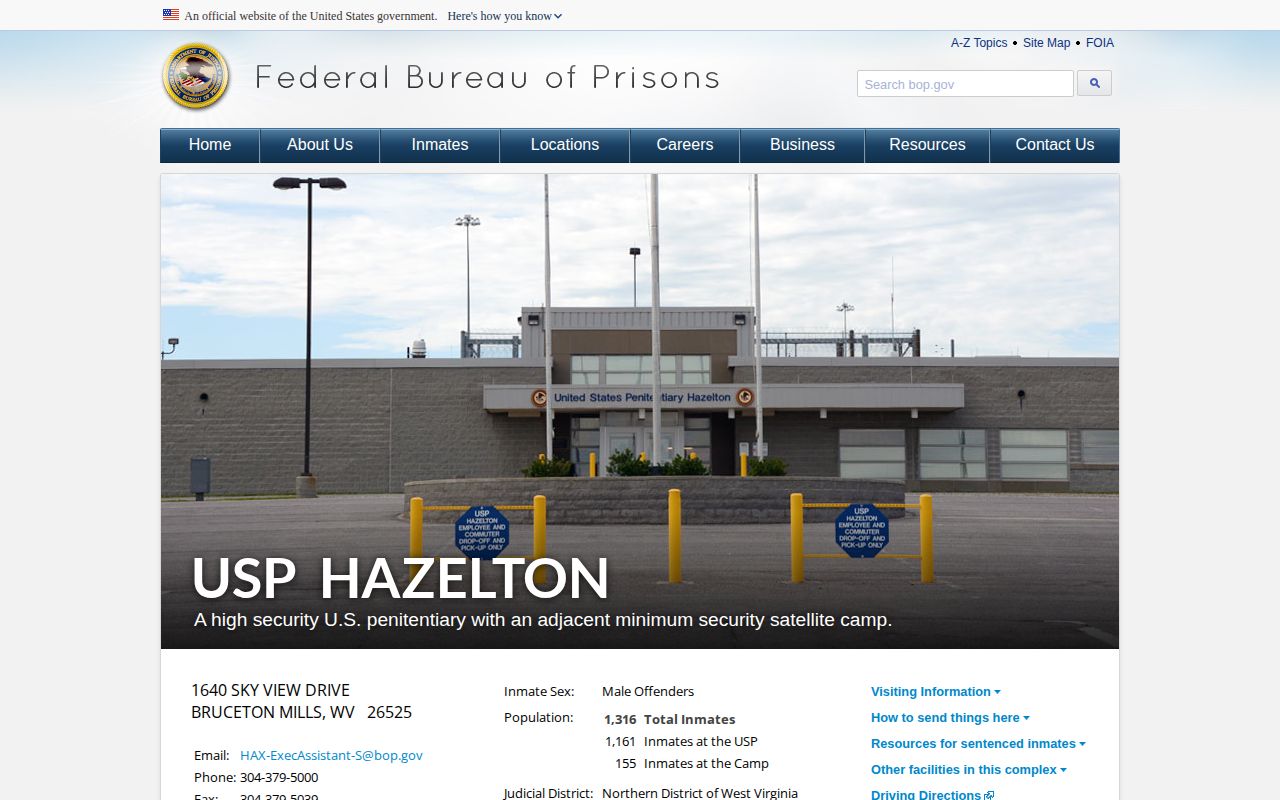
Matching the institution matters because FCC Hazelton includes more than one BOP component. A record tied to FCI Hazelton should not be described as a USP release. Use the exact name from the locator or formal BOP record.
Request USP Hazelton Release Records
If the public locator is too limited, request the existing federal record from BOP through its formal records process. Identify the person by full name, register number, date of birth, institution, and a narrow date range. Ask for the release or transfer date, disposition, destination or receiving agency when releasable, and the record that authorizes or documents the custody change.
The federal court docket is a separate source. It can show the judgment, commitment, sentence, later modification, and supervised-release terms. A court release order still does not prove exact physical departure. The BOP event provides the prison-custody side of the timeline. When a formal certified record is needed, use BOP or the court rather than treating an old locator screenshot as final.
After a USP Hazelton Release
Federal supervised release is imposed by a court and follows imprisonment under stated conditions. It differs from West Virginia parole or county probation. The federal docket and supervising federal probation office are the proper sources. A BOP “Released” result does not mean all court obligations ended.
| Result or event | What follows |
|---|---|
| BOP transfer | Search the new BOP location; custody continues |
| BOP released status | Check the federal docket and supervision terms |
| Release to ICE | Use the ICE detainee locator and information line |
| State or local hold | Follow the receiving state or jail agency |
| No locator result | Verify spelling, number, record age, and formal records routes |
Do not collapse these paths into one “free” status. Each agency can end its custody while another begins.
USP Hazelton and ICE Transfers
If a BOP or court record identifies ICE, use the ICE Online Detainee Locator. It commonly allows a nine-digit A-number plus country of birth, or exact biographical information with country and date of birth. A no-result is not final because public scope, spelling, update timing, age, and the recent-release window can affect the search.
An end to BOP custody followed by ICE detention is an interagency transfer, not community release. Conversely, an ICE release result ends immigration detention but does not erase federal supervised release or another case. Obtain the destination field when possible. For federal pretrial or transport custody involving USMS, use the federal docket and a focused USMS inquiry because USMS has no full public former-detainee locator comparable to BOP.
Preston's Two Custody Geographies
Preston County has a distinctive split. County arrestees travel outside the county to Tygart Valley Regional Jail in Randolph County. At the same time, FCC Hazelton, including USP and FCI components, sits inside Preston. A search based only on the place name “Preston County” can therefore select the wrong system.
Start with custody type. A county arrest points to WVDCR's regional-jail search. A West Virginia felony commitment points to the WVDCR prison search. A federal sentence points to BOP. Federal pretrial detention points to the federal docket and USMS route. Immigration detention points to ICE. The Preston County released inmate search lays out those branches for a person whose custody type is uncertain.
Verify a USP Hazelton Record
Never match a federal record by name alone. Use the BOP register number, date of birth, age and other lawful public identifiers, institution, sentencing court, and docket number. Similar names can occur across WVDCR, court, BOP, and ICE systems. Record where and when each search was run.
Describe the strongest supported fact. A docket judgment proves judicial action. A BOP locator result reports BOP status. A BOP release record documents the federal prison event. An ICE result belongs to immigration custody. When results appear to conflict, keep them separate until the formal agency record or corrected court order resolves the sequence. That approach preserves both accuracy and the dignity of the person being researched.
A locator result may be enough for an initial status check, but a formal matter calls for the underlying record. Preserve the register number, full result wording, release date, and query date. Then obtain the federal judgment, any amended order, and the BOP record needed to show the actual sequence. If another agency appears, document its intake or release separately. One agency's result should never be expanded beyond the custody that agency reports.
Public Record Search
Sponsored Results